Most Popular Home Battery Systems — What People Are Actually Installing
The home battery market has changed dramatically. Two years ago, the answer to “which battery should I get?” was relatively simple. Now there are dozens of brands competing in every major market, prices have dropped significantly, and the leading brands vary depending on where you live.
This post looks at the battery systems people are actually installing — based on market data, installer feedback, and what we see being used on the Photonik design platform — and the trade-offs involved in choosing between them.
Which batteries are most popular? It varies by region
One of the most striking things about today’s battery market is how different it looks in each region.
Australia has the most diverse market. Sigenergy has risen from relative obscurity to the #1 brand by market share (~25%) in under two years, overtaking Sungrow and Tesla. Over 50 brands are active, and the federal battery rebate has accelerated installations significantly.
Top brands: Sigenergy, Sungrow, AlphaESS, Tesla, GoodWe
The United States is the opposite — Tesla’s Powerwall 3 holds around 63% of the market, and together with Enphase, those two brands account for over 90% of residential installations. Everyone else is fighting for scraps.
Top brands: Tesla, Enphase
The UK was led by GivEnergy, a local brand that became a domestic favourite, however has recently we have seen many negative reviews for its poor support. Tesla is still popular as the premium alternative and Sigenergy is growing fast.
Top brands: GivEnergy, Tesla, Sigenergy, Myenergi Libbi
South Africa is unique — grid instability and load shedding have made batteries a near-necessity rather than a nice-to-have. The market is well-established, with a mix of international and locally made options. Pylontech, Dyness, and Hubble are among the most widely installed. Hubble is assembled locally in Johannesburg and known for fast warranty service. Sunsynk (the local name for Deye) dominates the inverter market and has a strong battery presence. Freedom Won, a local manufacturer, was named preferred battery brand in a 2024 installer survey.
Top brands: Pylontech, Dyness, Hubble, Sunsynk (Deye), Freedom Won
Germany and the EU lean toward performance-tested systems, with efficiency ratings carrying more weight than in other markets.
Top brands: BYD, Huawei, RCT Power, Fronius, KOSTAL
There is no single “best battery.” The right choice depends on your region, your inverter, your budget, and what you value most.
Seven systems worth knowing about
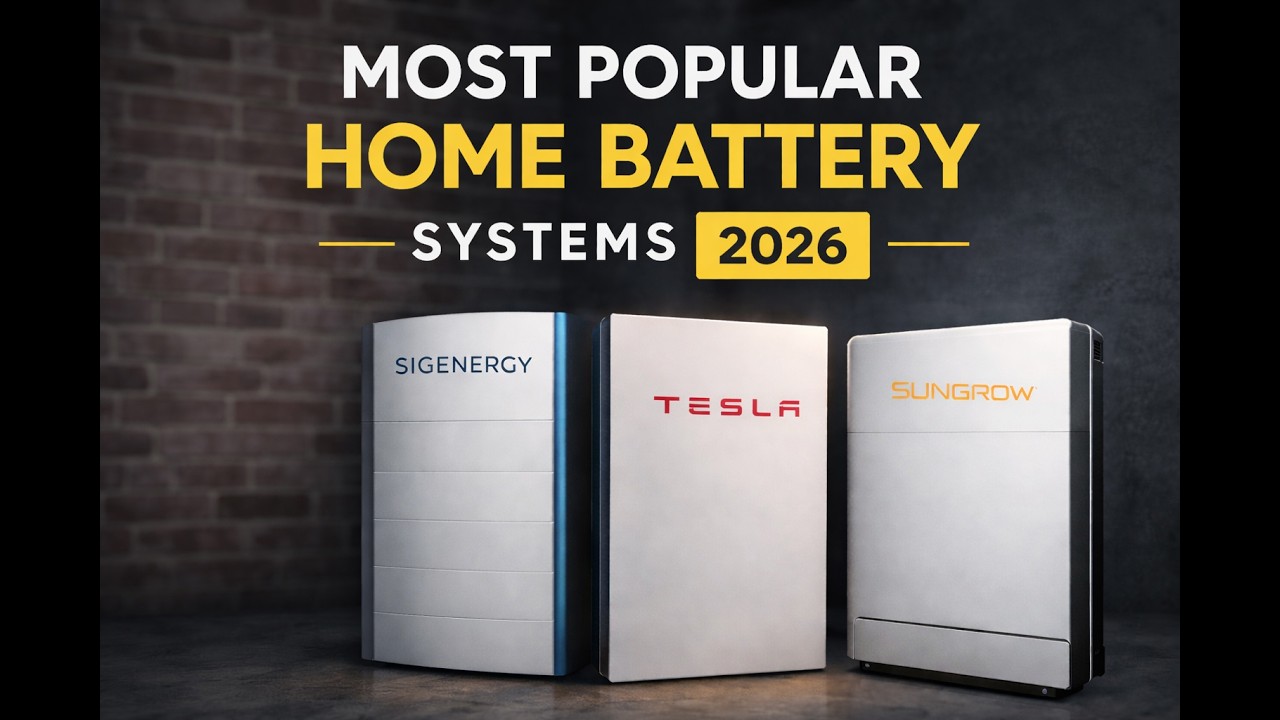
Sigenergy SigenStor
The fastest-growing battery brand globally. Sigenergy’s all-in-one system combines a hybrid inverter, modular LFP battery (5kWh or 8kWh modules, up to 48kWh), and an optional bidirectional EV charger — a combination no other brand currently offers in one unit. Founded by former Huawei engineers, the company now holds the #1 spot for stackable residential energy storage worldwide. Pricing is competitive for the feature set. The main question is longevity — the product is only a few years old.
Sungrow SBR
The steady performer. Sungrow was the #1 battery brand in Australia in 2024 and remains one of the most installed globally. Their high-voltage SBR modules (3.2kWh each) are modular and efficient, with 100% usable capacity. The trade-off: they only work with Sungrow hybrid inverters, so you are locked into the ecosystem. For many installers, that is fine — Sungrow inverters are well-regarded.
Tesla Powerwall 3
The name everyone knows. The Powerwall 3 is an all-in-one hybrid system: 13.5kWh battery, 11.5kW solar inverter, six solar inputs (MPPTs), and very high backup power. It dominates the US market. In Australia, however, Tesla’s share has been declining — partly because the Powerwall only comes in one size (13.5kWh), making it less flexible than modular competitors. It is a premium product at a premium price, but the brand confidence and backup power capability are genuine strengths.
BYD LVS / HVM
BYD pioneered the modular tower battery concept and remains one of the most trusted names globally. Their LVS (48V) and HVM (high-voltage) systems are available in small increments and are compatible with more inverter brands than almost any other battery — Fronius, SMA, Victron, Sungrow, GoodWe, Solis, and others. In Germany and across Europe, BYD is a staple. The warranty (10 years to 60% retained capacity) is modest compared to some newer competitors, but the track record is long.
AlphaESS SMILE
AlphaESS has quietly built a strong position — #2 or #3 in Australia with over 200,000 systems installed worldwide. Their SMILE series offers a DC-coupled hybrid system with modular LFP batteries, scalable from 5kWh upward. Pricing is competitive, and the current M-Series has improved significantly over earlier generations. A solid value-tier option with growing local support networks.
Deye
Deye is already one of the most popular hybrid inverter brands in the world (also sold as SunSynk, Sol-Ark, and Noark in different markets). They have more recently released their own battery systems, and early reviews highlight impressive build quality — one teardown described the engineering as “incredibly oversized and thought out.” The 10.2kWh LFP battery (6,000+ cycles, IP65 rated) pairs naturally with Deye inverters. As a battery brand, Deye is still proving itself, but the inverter track record gives confidence.
Ruixu Lithi2-16
One to keep an eye on. The Ruixu Lithi2-16 is a 16kWh, 48V LFP battery with standout specs on paper: 9,500+ cycles claimed, IP65 outdoor rating, self-heating for cold climates, built-in wheels, and an aerosol fire extinguisher. It received CEC approval in Australia in mid-2025 and is gaining traction among experienced installers. The brand is newer and lacks independent long-term testing data, but the specs and early feedback have been positive. Compatible with Deye, Growatt, Solis, and SMA inverters.
Quick Comparison Table
| Spec | Sigenergy SigenStor | Sungrow SBR | Tesla Powerwall 3 | BYD HVS/HVM | AlphaESS SMILE-M5 | Deye RW-F | Ruixu Lithi2-16 |
|---|---|---|---|---|---|---|---|
| Battery size | 6–100+ kWh | 6.4–25.6 kWh | 13.5 kWh | 5.1–66.2 kWh | 5–80 kWh | 5.3–164.3 kWh | 16 kWh |
| Modular? | Yes (6/9 kWh modules) | Yes (3.2 kWh modules, 2–8) | No (single unit; stack up to 4) | Yes (2.56/2.76 kWh modules) | Yes (5 kWh modules, 1–6) | Yes (5.3/10.2/16 kWh units, up to 16–32 parallel) | No (single unit; up to 32 parallel) |
| Usable capacity | 97% | 100% | 85% (11.5 kWh of 13.5) | 96%+ | 96–100% | ~90% DoD | ~80% DoD (9,500 cycles) |
| Included inverter? | Yes, 3.8–11.5 kW (single SKU, field-configurable) | No (separate) | Yes, 5.8–11.5 kW (model dependent) | No (separate) | Yes, 5 kW hybrid | Yes (3.6 kW in RW-F5.3 all-in-one); No for standalone battery units | No (separate) |
| AC or DC coupled | DC-coupled (4 MPPT, 2:1 DC oversizing) | DC-coupled (with Sungrow SH inverters) | DC-coupled (built-in solar inverter) | AC or DC (depends on inverter pairing) | DC-coupled (2 MPPT, 200% PV oversizing) | DC-coupled (with Deye hybrid inverters) | AC-coupled (pairs with external inverters) |
| Continuous power (kW) | Up to 11.5 kW | ~15 kW (SBR256) | 11.5 kW (up to 15.4 kW off-grid) | 12.8 kW (HVS) / 12.8 kW (HVM) | 5 kW | 3.6 kW (all-in-one) | Depends on inverter |
| EV charging | Yes — 25 kW bidirectional DC charger module | No | No (separate Tesla Wall Connector) | No | No | No (but Deye inverters support load management) | No |
| V2G / V2H | Yes (V2H and V2G via CCS2) | No | No (not yet) | No | No | No | No |
| Backup power | Yes — 0 ms switchover | Yes — <20 ms switchover | Yes — seamless (built-in) | Yes (depends on inverter) | Yes — built-in changeover switch | Yes — 4 ms switchover | Yes (depends on inverter) |
| Warranty | 10 years (15 yr optional in AU/NZ) | 10 years / 10,000 cycles | 10 years (70% capacity retention) | 5 yr product / 10 yr performance (if connected) | 10 years (80% capacity retention) | 5 yr (10 yr extendable) | 10 years |
| Cycle life | ~8,000 (based on throughput limits) | 10,000 cycles | Not officially stated | ~6,000 cycles | ~6,000+ cycles | 6,000+ cycles | 9,500 cycles |
| Round-trip efficiency | 97.8% (inverter) | ~97% (DC) | 89% (solar → battery → home) | 96%+ | ~95% (estimated) | ~95% (estimated) | ~95% (estimated) |
| Chemistry | LFP (LiFePO₄) | LFP (LiFePO₄) | LFP (LiFePO₄) | LFP (LiFePO₄, cobalt-free) | LFP (LiFePO₄) | LFP (LiFePO₄, cobalt-free) | LFP (LiFePO₄) |
| Indoor/outdoor | Outdoor (IP66, built-in heater) | Indoor/outdoor (IP55) | Indoor/outdoor | Indoor/outdoor (IP55) | Outdoor (IP65) | Outdoor (IP65) | Outdoor (IP65, self-heating, electro-coated) |
| Weight | ~40 kg per 9 kWh module | ~33 kg per 3.2 kWh module (279 kg total for 25.6 kWh) | 130 kg (13.5 kWh) | ~27 kg per module (HVS+/HVM+) | ~varies by config | ~71 kg (5.3 kWh all-in-one) | ~140 kg (16 kWh) |
| Inverter compatibility | Sigenergy only | Sungrow SH series only | Tesla only | Fronius, SMA, GoodWe, Victron, KOSTAL, KACO, and more | AlphaESS only (built-in) | Deye/SunSynk only | Open — CAN-bus and RS485 (multi-brand) |
| Price tier | Premium | Mid | Premium | Mid | Value–Mid | Value | Value |
The premium vs. value question
Battery prices vary enormously. A premium all-in-one system can cost more than double a value-tier alternative for similar storage capacity. Premium systems typically come with longer warranties, proven track records, and established support networks. Value systems offer lower upfront cost but carry more uncertainty.
The solar industry has seen this pattern before. When cheap inverter brands entered the market a decade ago, many failed within a few years. Getting a warranty claim honoured was often difficult — some brands had no local presence at all. The same risk exists with budget-tier batteries today. We are not naming specific budget brands here, but if a battery price seems too good to be true, it is worth asking: who backs the warranty, and will they still be around in five years?
There is a meaningful difference between “value” and “budget.” Brands like AlphaESS, Deye, and Ruixu sit in the value range — competitive pricing from credible companies with growing track records. Below that, the budget tier is populated by new entrants with limited history. Caution is reasonable.
Key Takeaways
| Consideration | Best option(s) |
|---|---|
| Widest inverter compatibility | BYD (works with almost everything); Ruixu (open protocol) |
| Locked ecosystem (simplest install) | Tesla, Sigenergy, AlphaESS, Sungrow |
| Highest cycle life | Ruixu (9,500), Sungrow (10,000) |
| Best value per kWh | Ruixu, Deye, AlphaESS |
| EV charging integration | Sigenergy (only brand with built-in bidirectional DC charger + V2G) |
| Largest scalability | Deye (512 kWh), Ruixu (512 kWh), Sigenergy (100+ kWh) |
| Best backup performance | Sigenergy (0 ms), Tesla (seamless), Deye (4 ms) |
| Best warranty | Sungrow (10 yr / 10,000 cycles), Sigenergy (up to 15 yr in AU/NZ) |
What are you seeing?
Battery choice is one of those topics where real-world experience is more valuable than spec sheets. If you are an installer — what systems are you recommending, and why? If you are a homeowner — what did you choose, and how has it performed?
A few questions worth discussing:
-
Are value-tier batteries proving themselves, or are you sticking with established names?
-
How important is inverter compatibility in your decision — do you prefer open systems (BYD, Deye) or integrated ecosystems (Sungrow, Tesla, Sigenergy)?
-
For those in the US — is there a reason to look beyond Tesla and Enphase?
If you want to compare how different battery systems affect payback and self-consumption for your own situation, you can model it using the free solar and battery design tool on Photonik.