We built a model that estimates solar savings across 32 countries — but solar models are tricky. There are so many variables that can change results dramatically! We want to know if these numbers match what you actually see in real life.
Here are our findings, do they match with your reality?
UK — Our model shows ~$27k in 25-year savings for solar-only. That seems high for a cloudy country, with very little winter sun.
India — Slow payback, modest savings in our data. Does that reflect reality, or are we missing something?
Australia — Solar-only looks weak now (low export rates). That seems realistic now. Battery savings and payback look very strong though.
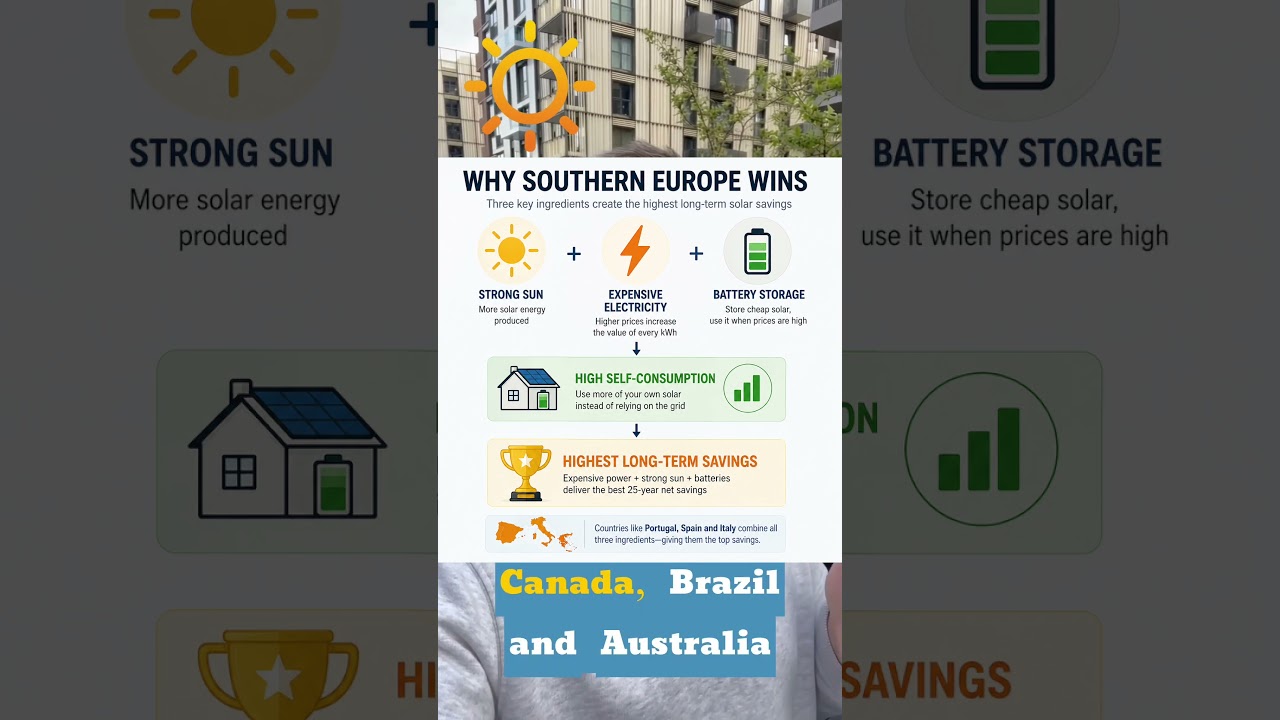
Southern Europe — Spain, Portugal, Italy show ~$30k over 25 years with a battery. Too optimistic?
If your country isn’t listed, we’d love to know about the savings you are getting.
Payback video summary
Savings video summary
Question for the community:
If you have solar or are an installer, please share three things:
Where are you (country, and city or state)?
What did your (or your customer’s) system cost?
How much do you save a month, and how long is it taking to pay back?
@Marty Was going to give the same answer as you when i read the post but might have been for a different reason. Location matters for several things. One is local prices of Solar Panels and inverters. Another is the electricity tariff and local regulations and compensation for Grid Feed in (Net billing or Net metering). Then there is climate zone (sunshine hours / intensity and snow).
If you location offers an acceptable feed in tariff or Net metering, you want to go with an On Grid system. If not you have to go with a Hybrid system and batteries. I live in Thailand and can import from China at low cost. So the price I pay for a 650w solar panel is about 2500 Thb (80 USD) and a 15kwh LifePo4 battery is about 30’000 THB ( 900 US).
I have a 20kw system, Today’s costs would be 30 panels at 2500 THB = 75000 THB. A good 20kw Inverter is 120’000 (you can get cheaper ones starting at 40’000. I tried that and it literally blew up one day when i started my garden sprinkler pump). Installation and cables where 50’000,
So total costs of 245 000 THB.
I share excess with a private residential microgrid using net metering. The electricity Tariff is 2.6 THB off peak (night) and 4.2 THB per kwh Peak (daytime). sunshine hours are from 6am to 6 pm, so I calculate 6 hours at 40% of max capacity (in my case 20kw). this gives me 6 x 8 kWh = 48 kwh a day. Thailand has no snow in winter, so multiplied by 365 = 17520 kwh at 4.2 THB.
Thats 73’584 THB savings per year.
This gives me a ROI of around 3 /12 years.
But that’s because my local conditions are almost optimal. Without micro grid it would go up to about 6-10 years. Sadly this will be the case in 2 month, since some of my neighbors are willing to pay 20% higher power bills in order to leave the micro grid. And all just because they do not want me to benefit from it. ( they are old and simply hate to have a neighbor half their age living in a bigger House than them)
Panels last 20 years, Inverters about 7-12 years and batteries 5-8 years.
Sorry, i made a mistake. Just checked my inverter Numbers and average production per day is around 90 kwh. So annual savings are 137’970 THB. So my ROI is 1.7 years.
Thanks @alain (I’ve moved your post over to this more apt topic), super interesting to see a real world case study. Our calculations show 6.7yr payback for solar in Thailand, and over 10 years for solar + batteries! Just goes to show how much variables like battery cost can change the economics. Battery cost is so variable even within countries, let alone globally.
This is the data I have, where are we going wrong?
Based on: 15 kWh/day usage · 6.6 kW solar · 10 kWh battery · Mid range quality tier
That statistic is super useful. What you could correct about Thailand is the Grid retail price and buy sell local price. You can find the retail prices for thailand here , but it will change again soon. bangkok post article Its also just the base tariff. In reality you would have to add 7.5% VAT and Fuel Tax (FT) that changes every 4 month (over the last 6 years it varied from min -0.5 to max 2.5 THB). 3.77 might be valid for systems with batteries, but quite low for On gird systems without net metering (like most of the rooftop solar systems in Thailand). I was keeping track of the utility data of our gated community since 2018. You can find it here if you want some practical data.
The official feed in Tariff is currently 2.2 THB. (also mentioned in the Bangkok post article)
What causes most of the difference with my case is that i am connected to a private micro grid and able to share excess solar with 25 neighbors using Net metering. (sadly this will change in a view month time).
If you are interested in some more data.. I was just talking about the solar system at my home till now.. But I own 3 apartment buildings and other rental properties in Thailand with a total of 5 solar systems installed on them. 2 are with 20 kw Deye hybrid inverters and multiple JK Bms batteries in parallel. The other 3 are Huawei On grid systems
Some of them would have even shorter ROI periods then my home, since i sell 100% of the produced power to the Tenants at a rate of 6 THB/KWH (for apartments usually the price is 8 THB /kwh). In some cases the ROI is less then a year.

 but might have been for a different reason. Location matters for several things. One is local prices of Solar Panels and inverters. Another is the electricity tariff and local regulations and compensation for Grid Feed in (Net billing or Net metering). Then there is climate zone (sunshine hours / intensity and snow).