Is it worth getting batteries with your solar system?
For more than a decade, the standard answer was no — payback rarely stacked up. That has changed. In some situations, a battery can now pay back faster than solar alone. The outcome depends on a handful of variables that are worth understanding before you decide.
Let us know your own experience below. Have you got a battery, or are you considering one?
Why the economics have shifted
Three factors have moved the needle on battery economics.
Cost. Lithium-ion battery prices have fallen by around 80–90% over the past ten years. Mass production and improved technology have made storage significantly cheaper.
Electricity Tariffs. Wholesale-style tariffs for households are becoming more common. That means very low — sometimes zero — prices when solar output is high. A battery can store that cheap energy for use when grid prices rise. A solar system is not even required for this to work.
Government Support. Rebates and incentives for battery storage are available in many regions. In Australia, for example, new STC rebates for batteries are cutting upfront cost by thousands. It is worth checking what applies in your area.
The old rule — “batteries don’t pay back” — no longer holds in the way it once did. Use the Photonik solar design tool to model your own situation and see if a battery is worth it.
Payback and self-sufficiency
For an average system in Australia, payback with a battery is only slightly longer than without — typically around 5 years for solar alone versus about 5½ years with a battery included. In many cases, the trade-off in payback is small relative to the gain in energy independence.
In other markets (e.g. US, UK, South Africa), adding a battery often extends payback by a couple of years, so the purely financial case is a bit weaker. Payback is not the only consideration: in places like South Africa, grid reliability has made the independence offered by a battery valuable beyond the raw numbers.
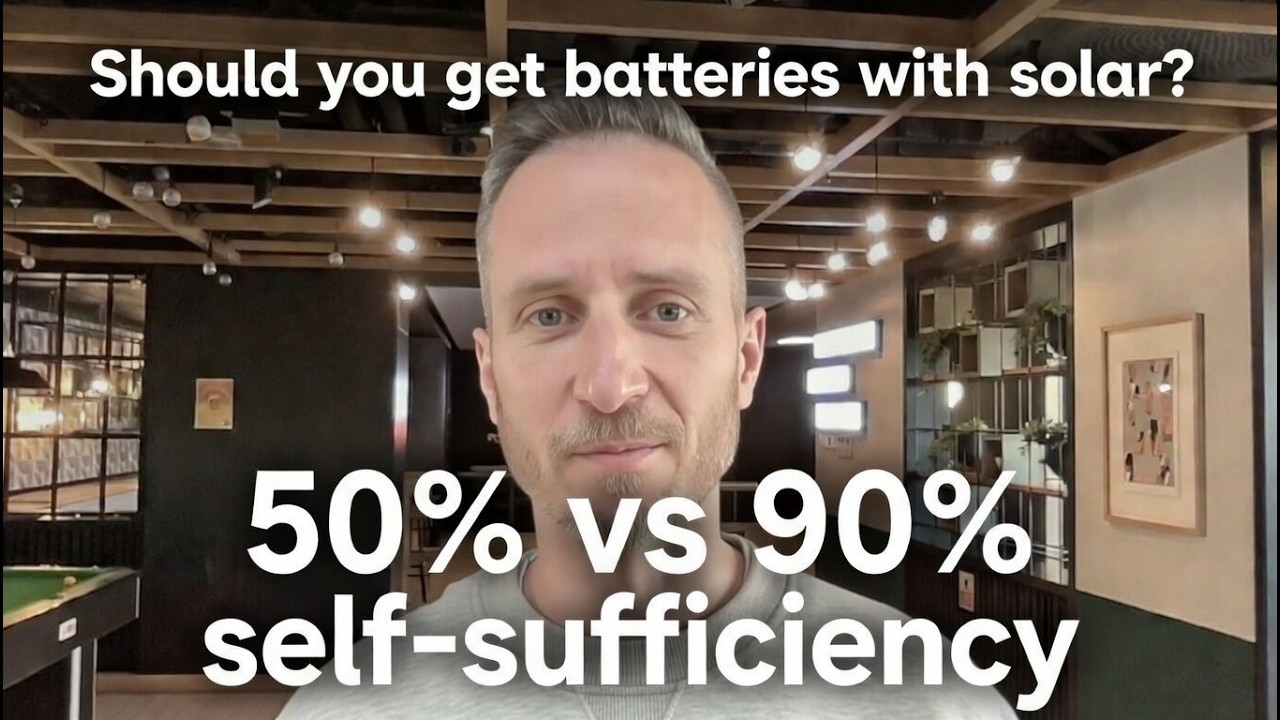
That independence is measurable. With solar only, a typical household might sit around 50% self-sufficient — half of the electricity used comes from the panels. With a well-sized battery, that figure can reach around 90%. There is also a practical difference during outages: a solar-only system typically shuts down when the grid fails, while a hybrid system with a battery can keep critical loads running.
“Average” does not apply to every home. Outcomes depend on several variables, which are worth modelling for your own situation.


Five variables that shape your result
Battery choice. Storage costs vary widely. Premium brands (e.g. Enphase) can be more than twice the price of budget-tier options (Pylontech, GenZ, Sungrow, BYD). Premium units often come with longer warranties and different features; the important point is that there is no single “cost of a battery.” Different battery options can be compared in the Photonik design tool to see how they affect payback and savings.
Usage profile. Payback is strongly influenced by when electricity is used. Households that consume heavily during the day — pool pump, air conditioning, washing — and use their solar directly may see longer battery payback. Those who are away during the day and use most power in the morning and evening export when prices are low and buy when they are high; in that pattern, a reasonably priced battery can deliver faster payback than solar alone. Usage patterns can be adjusted in Photonik to see the impact on the numbers.
Location. Site affects both generation (sunnier regions produce more) and, in Australia, STC rebate amounts, which can materially reduce upfront cost. Photonik uses your address to model generation and applicable rebates.
System size. Array size matters. Too small, and the battery is underutilised; too large, and export dominates. The right balance between solar size, battery size and consumption is part of the equation. The tool supports trying different system sizes and panel layouts to see the effect on payback and self-consumption.
Tariffs. Grid rates, export rates and plan structure (e.g. time-of-use, feed-in tariffs, daily charges) all change the economics. Different tariffs can be entered so you can see how your current or potential plan affects payback.
Summary
These variables can move payback by several years. For a battery system, payback might sit anywhere from roughly 5 years to 10 years or more. There is no single answer — only an answer for your specific setup.
The Photonik design tool accounts for all of these factors. Running your own address and assumptions will show your likely payback, self-consumption and how a battery changes the outcome.
The most important decision remains who you buy from. Getting a quote from a reputable, experienced installer is the best way to navigate the choices involved in going solar — with or without a battery.